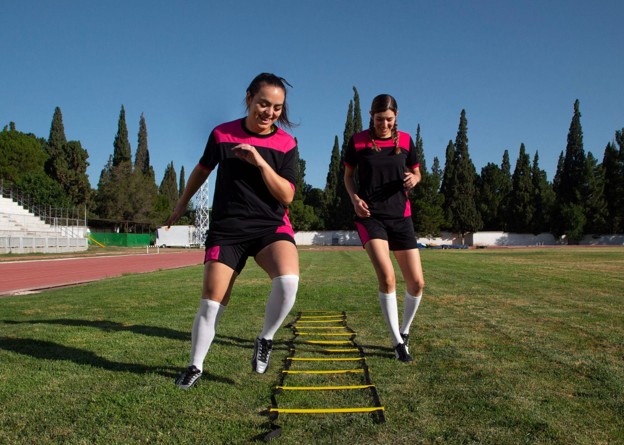
Distance running, cycling, and other endurance sports are often associated with steady, repetitive movement rather than rapid directional changes. Yet Kevin Morgan of Rochester explores why agility training has become an increasingly valuable component of endurance performance, helping athletes improve coordination, neuromuscular efficiency, movement quality, and resilience. While agility drills are commonly linked to field and court sports, they also offer important benefits that support long-term durability and more efficient movement in endurance athletes.
Traditional endurance training typically emphasizes aerobic capacity, strength, and mileage. These elements remain essential, but modern performance science increasingly recognizes that efficient movement depends on more than cardiovascular fitness. The nervous system, musculoskeletal coordination, and balance all contribute to how effectively an athlete performs over time.
Agility training helps develop these systems by introducing controlled movement patterns that challenge the body in ways repetitive endurance training often does not.
Understanding Agility Beyond Change of Direction
Many people define agility simply as the ability to change direction quickly. While this is one aspect of agility, the concept is much broader.
Agility also involves:
- Coordinating movement efficiently
- Maintaining balance during dynamic motion
- Reacting to changing environments
- Controlling body position
- Producing and absorbing force effectively
For endurance athletes, these qualities influence movement economy even when racing on relatively straight courses.
The ability to move efficiently is not determined solely by fitness. It also depends on how effectively the nervous system coordinates muscles throughout each stride or pedal stroke.
Improving Neuromuscular Efficiency
Every athletic movement begins with communication between the brain and the muscles. The faster and more efficiently this communication occurs, the smoother movement becomes.
Agility exercises stimulate this connection by requiring athletes to:
- Adjust foot placement
- Maintain body control
- Coordinate multiple muscle groups
- Respond to movement cues
- Stabilize during dynamic actions
These activities improve neuromuscular efficiency, allowing movement patterns to become more coordinated and economical.
For endurance athletes, greater efficiency means less wasted motion and improved consistency throughout long training sessions and competitions.
Enhancing Running Economy
Running economy refers to the amount of energy required to maintain a given pace. Even small improvements in movement efficiency can produce meaningful performance benefits over long distances.
Agility training contributes by encouraging:
- Better posture during movement
- More efficient foot placement
- Improved joint stability
- Faster muscular coordination
- Greater control throughout the stride cycle
Rather than making athletes faster through speed alone, agility helps reduce unnecessary movement that can gradually increase fatigue.
Over time, improved movement economy supports more sustainable performance.
Building Durability Through Movement Variety
Endurance sports often involve repeating nearly identical movement patterns thousands of times during a single training session.
While repetition develops sport-specific fitness, it can also create muscular imbalances if athletes neglect movement variability.
Agility drills introduce new challenges by requiring:
- Lateral movement
- Rotational control
- Single-leg stability
- Multi-directional coordination
- Controlled acceleration and deceleration
These movements strengthen supporting muscles that may receive less attention during traditional endurance training.
A more balanced movement system contributes to greater durability across an entire training season.
Supporting Injury Prevention
No exercise can completely eliminate injury risk, but well-designed agility training may reduce some common contributing factors.
Many overuse injuries develop when repetitive stress is combined with poor movement mechanics or muscular weaknesses.
Agility exercises help athletes improve:
- Balance
- Joint control
- Landing mechanics
- Hip stability
- Dynamic coordination
By improving these qualities, athletes may better tolerate the physical demands associated with high-volume endurance training.
The objective is not simply to move more, but to move better.
Developing Better Body Awareness
One of the less obvious benefits of agility training is improved proprioception, the body’s awareness of its position and movement.
Athletes with stronger proprioceptive abilities often demonstrate:
- Better posture
- Quicker movement corrections
- Improved balance
- Greater confidence on uneven terrain
- More consistent mechanics during fatigue
This awareness becomes increasingly valuable during long races when maintaining efficient movement can become more challenging.
Improved body awareness also allows athletes to recognize inefficient movement patterns before they contribute to discomfort or injury.
Practical Agility Drills for Endurance Athletes
Agility training does not require extensive equipment or lengthy workouts.
Simple exercises may include:
- Agility ladder drills
- Cone movement patterns
- Lateral shuffle exercises
- Single-leg hopping progressions
- Multi-directional balance drills
- Reaction-based footwork activities
These exercises can often be incorporated into warm-ups or short supplementary training sessions without interfering with endurance-focused workouts.
Consistency is generally more important than complexity.
Integrating Agility Into a Training Program
Agility should complement, not replace, traditional endurance training.
Athletes often benefit from performing agility exercises:
- Before speed workouts
- As part of dynamic warm-ups
- During strength training sessions
- On lower-volume training days
This approach improves movement quality while allowing athletes to maintain appropriate recovery.
Like any training method, agility exercises should be introduced gradually and matched to an athlete’s current fitness and experience level.
Looking Beyond Traditional Training Models
Endurance training continues to evolve as research expands understanding of athletic performance.
Today’s athletes increasingly recognize that success depends on multiple interconnected systems, including:
- Aerobic fitness
- Muscular strength
- Coordination
- Recovery capacity
- Neuromuscular efficiency
Agility training supports these broader performance qualities by encouraging athletes to develop movement skills alongside endurance.
Rather than viewing agility as exclusive to sports requiring rapid directional changes, endurance athletes can use it to improve overall athleticism and long-term performance.
Conclusion
Agility training offers endurance athletes benefits that extend far beyond speed or quick directional changes. By improving coordination, neuromuscular efficiency, balance, and movement quality, these exercises help athletes develop greater durability and more efficient movement patterns.
When integrated thoughtfully into a comprehensive training program, agility training complements traditional endurance work by strengthening the systems that support consistent performance. As understanding of human movement continues to evolve, endurance athletes who embrace a broader approach to training may be better prepared to perform efficiently, adapt to challenges, and sustain long-term athletic development.
